
Both the state of Michigan and the city of Detroit are facing upcoming budget crises. The state is staring at a $370 million deficit, while the much-smaller city of Detroit forecasts a $214 million shortfall if it cannot balance its budget by July 1, 2005.
Cost-cutting - including layoffs and department mergers - as well as possible tax increases, are some of the options that both offices have considered as possible means to fill-in their budget shortfalls. And, just a few weeks ago, the public became privy to another possible solution - self-imposed salary cuts by governmental officers. In fact, Governor Granholm proposed a 5% salary cut for herself - which has already been approved by the Michigan Legislature - and has also requested a budget freeze for both herself and Michigan's Lieutenant Governor, John Cherry, which will extend through 2008. On a related note: Granholm also requested a 5% salary cut for Cherry, who the Free Press quoted as making an annual salary of $123,000.
Following the lead of Granholm, Detroit Mayor Kwame Kilpatrick has stated that he, along with three of his key cabinet members, will also take a reduction in pay in the upcoming fiscal year. Kilpatrick, who pulls in almost $177,000 per year, has yet to specify the exact reduction he or his officers will take. This article in the Detroit News stated that Kipatrick's top aides - Chief of Staff, Christine Beatty; COO Walter Watkins; and, new Deputy Mayor Anthony Adams - all make somewhere in the $140,000 range.
Although I would love to say that Detroit's City Council followed the examples of both the Governor and Mayor by voluntarily agreeing to cut their $81,000 salaries, this is not the case. And, not only have they not cut their salaries, this Metro Times News Hits article from 12/22/04 reports that the Council actually increased the size of its budget this year - to $16.9 million. This new figure allots $731,000 to each council member to spend at will, except for Council President, Maryann Mahaffey, who gets $1 million.
Hmmm...I just can't figure it out: we have a council with several members that are vehemently against layoffs, but keep making poor decisions in the wake of a major budget crisis. They continue to increase spending and their budgets, while the tax base continues to erode. I mean, What are they thinking? The only answer is that they are not (thinking).
I'd like to give them something to think about, then: Get with it, Council. It is time to step up - cut your salaries.
Saturday, January 08, 2005
Pay Cut for Council Long Overdue


Friday, January 07, 2005
Houston Now Nation's Fattest, Not Detroit
According to the seventh annual, "Fattest and Fittest Cities in America" put out by Men's Fitness magazine, Detroit is no longer the nation's fattest city - Houston is.
Detroit isn't number two, either - that title belongs to Philadelphia. Coming in third: Detroit. (Hey, it's better than being first or second.) Coming in fourth: Memphis. The fifth-ranking fatty? This honor is bestowed on our Midwestern neighbor, Chicago.
Seattle ranked number one as America's "most fit city".
Wednesday, January 05, 2005
Don't Crowd the Plow
Detroit has been blanketed by snow during the past 24 hours, and weather forecasters are predicting more of Mother Nature's white powder throughout tonight and tomorrow. (Hey, this wouldn't be Detroit without a 61 degree day on Sunday and a blizzard a few days later).
In the spirit of the cold, white weather we have all experienced today, I thought it would be fun to share some information on Detroit's salt mines, the intriguing and mysterious "other world" that lies just below southwest Detroit and its close suburban neighbors, Allen Park and Melvindale.
Located 1100 feet below Detroit's surface, lie over 100 miles of tunnels - salt mine tunnels - that, up until 1983, were filled with miners that worked to bring the salt to the surface. As Detroit was the first place in the nation that rock salt was used for ice control on roads and highways, the city experienced great profits from its natural resource. In addition to ice control, the products of Detroit's salt mines have also been used for meat preservation, as well as in the chemical industry. Due to falling prices and competition from Canadian salt mines, Detroit's salt mines closed in 1983. They were briefly reopened in 1998, when Crystal Mines bought the company and made tours of the mines were available. In 2000, the Detroit Renaissance - a private, non-profit group established in 1970 to help Detroit bring itself back to its former glory - assisted in securing funding for the mine's reopening as a salt production center. Bought from Crystal Mines at that time, the Detroit Salt Company, LLC, discontinued mine tours due to safety reasons.
Detroiters aren't the only ones who use the natural products from Michigan's salt, though. According to a report on the website of the Salt Institute, much of the nation's rock salt comes from the mines under Detroit. In addition, scientists believe that the natural resource was also used by prehistoric animals, such as the mastodon, in the form of natural salt licks.
Tuesday, January 04, 2005
Traffic affects more than those caught in it
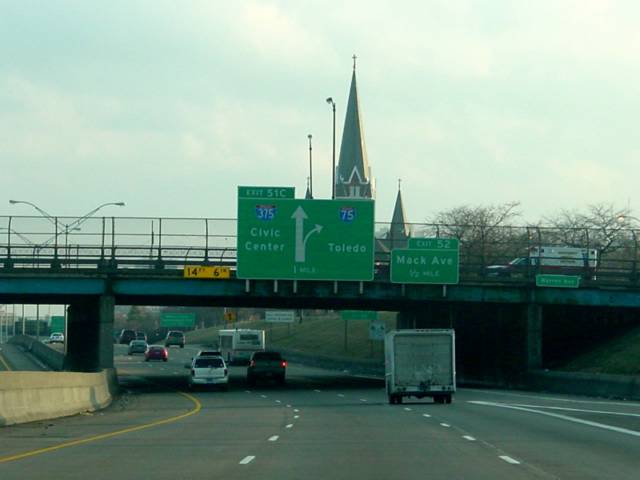
I-75 headed towards Detroit
I cannot tell you how much I love my commute to and from work every day - no, I am serious: I love it. It is so great to know that I am driving 8 miles and it is only going to take me about 13 minutes. No congested traffic to worry about; no stop-and-go, stop-and-go; and absolutely, positively, no stress or pounding my fists against the dashboard when I have only moved a quarter-mile in 20 minutes.
I know all of you out there that live in the second and third ring suburbs know exactly the type of traffic congestion I am talking about. I knew it firsthand when I used to live in Shelby Township and had to drive to work in Royal Oak every day. Even though it was only a 20-mile drive, it would take me 45 minutes or more to get to work everyday! It was nuts. After a year of wasting precious hours behind the wheel, I finally decided I had had enough - I moved.
Along with the stress and wasted time that comes with living so far away from your job, though, there are numerous other negative effects that urban sprawl, or the act of moving further and further away from urban centers, cause. For example, did you know that air pollution, one result of the dangerous fumes emitted from vehicles, are a contributing cause of nearly 100,00 premature deaths each year? According to "Highway Health", a report done by Sierra Club International, this is double the number of people that die in car accidents each year. Also mentioned in the report are the effects sprawl has on the average worker's commute time - which increased by 1/3 from 1983 to 1995 - and the increased reliance we have on automobiles, which are now necessary in order to get from one store to another in the same shopping mall, resulting in less natural exercise.
Feel free to e-mail me at jaime.halaas@gmail.com
Saturday, January 01, 2005
History of Detroit's Pontchartrain Hotel
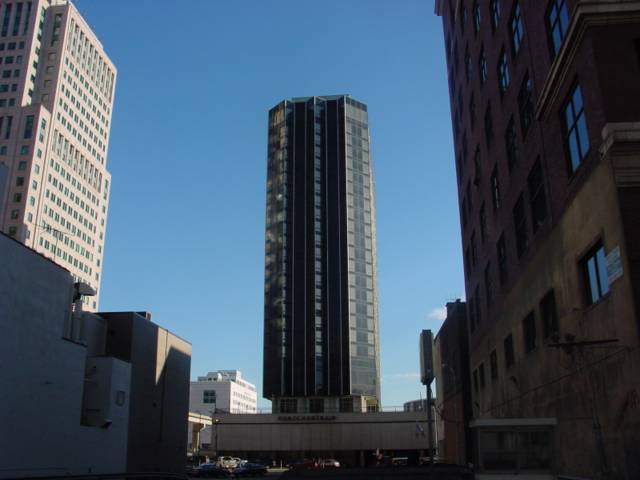
Detroit's Pontchartrain Hotel
The hotel that occupies the address 2 Washington Boulevard in Detroit sits on what most people consider the oldest French settlement in Detroit. Where the Pontchartrain now sits was where Antoine de la Mothe Cadillac - founder of Detroit - began construction of a fort on the river in 1701.
Named Fort Pontchartrain after the French government's Minister of the Colonies at the time - Jerome Phlypeaux, Compte de Pontchartrain - Cadillac called the area inside the fort Ville de Detroit, which means city or village of the straits. The original fort, which was bound by downtown Detroit's Washington Boulevard, Griswold, Larned and Atwater streets, served as a lookout facility to fend off the British and served the needs of the explorers and defenders of the French-occupied territory.
In 1760, the fort was taken by the British after the French's surrender in Montreal. The ownership of the land was then transferred into the hands of the United States in 1783 as a result of the Treaty of Paris.
The current occupant of the former fort's northwest corner is the Pontchartrain Hotel, aptly named to honor Detroit's first French Settlement. As a reminder of its roots, the lobby of the hotel features a plaque denoting the historical significance of the space.
The current hotel, built in 1963, contains 413 guest rooms and offers spectacular views of the Detroit River, as well as Windsor's skyline. The hotel's lobby, lounge and dining area were renovated in 2003.
More information on rates, as well as additional amenities for the Pontchartrain Hotel can be found on its website.

